“Mercy” – Whole School Prayer Resources
The Becket Way Focus
Notices
See
Think
Hear
Do
The Becket Way Focus
Notices
Welcome back everyone! Happy Easter, Alleluia!
We are in the 2nd week of Easter tide and the word of the week is Mercy
This week’s Prayer Intentions…
- We pray for the global church as we continue to celebrate Eastertide
- We pray for all of the young people and adults who joined the church over the Easter period
- We pray for world leaders, that they will be guided by the Holy Spirit to show mercy for the poorest in our world.
Please keep them in your prayers this week and don’t forget to add any suggestions for prayer intentions to the comments box below!
Celebration of the Word and Catholic Life Rota
Monday – Year 7 Chapel / Year 8 Hall
Monday Becket Reads – Becket way Assembly – Year 7 Chapel / Year 8 Hall
Monday lunchtime – Chapel open – Easter decorations, cards and jobs for anyone to join. News and Communications Team Meeting.
Tuesday – Year 9 Chapel / Year 10 Hall
Tuesday Becket Reads – Becket way Assembly – Year 9 Chapel / Year 10 Hall
Wednesday – 6th Form Chapel and Hall
Wednesday lunchtime – Chapel open – Eco and Sustainability Team Meeting in the chapel
Thursday – Year 11 Chapel
Friday 17th April – Year 7 Eastertide Retreat Day
Year 7 will be off timetable on Friday from P1-5. A timetable and new rooming will be shared with staff this week. Year 7 students will need to come to school in their full school uniform and with their usual equipment and conduct cards (colouring pens/pencils will be useful throughout the day if you have any you can bring in!). Year 7 students do not need to bring in their Friday books or PE kits unless told otherwise by their teachers or if they have a sports club.
Year 10 Notice – Briars meeting in the Chapel during Friday form time
All students who have signed up and started paying for the year 10 Briars retreat need to come to the chapel promptly on Friday morning. A register will be taken in the chapel.
If you are not sure if you are signed up to the retreat, please pop to the chapel to see Joe during a break or lunchtime.
It is really important that you attend this meeting promptly on Friday, we cannot run into lesson time and year 7 will be coming down for their retreat day.
A letter was sent home to parents before the Easter holidays, please make sure to return your parental consent health forms and behaviour contracts to the office or the chapel as soon as possible. You will not be allowed to attend the retreat unless these forms are returned correctly.
Thank you to our Passio Cast!
The last day before the Easter break was a busy one, and the Lenten mood was very different from the Eastertide atmosphere we return to! We would like to say a huge thank you and round of applause to the incredible Passio cast, along with Mr Lund and Mr Borrill, who led the school so beautifully on the final day through a powerful piece of liturgical theatre. Everyone involved was incredibly talented and brave, sharing their faith in such a creative and reverent way.
Here is a short reel from Passio in case you missed it!
See
Thank you to 9E for creating this week’s resources!
Good morning everyone, welcome back, we invite you to begin by making the Sign of the Cross:
In the name of the Father, and of the Son, and of the Holy Spirit. Amen.
Welcome back to school! As we settle into our final term (only two more half terms to go!), our community moves from the quiet and reflective preparation of Lent into the greatest celebration of the Church year – Eastertide!
In the Catholic tradition, Easter is not just one Sunday. It is a 50-day season of joy, lasting all the way until Pentecost. That means there is still so much Easter joy to share with one another.
Let’s head to 9E and our Becket community as we find out more about this week’s word of the week – Mercy!
Thank you to everyone who took part in the video!
There is still so much Easter joy to share — six more weeks, in fact!
So let’s share that joy now.
Please turn to the person either side of you and wish them a Happy Easter — Alleluia!
Time to Reflect and Share
After our time away, let’s take a moment to catch up.
You can share these questions with the people next to you, or as a whole form group discussion:
• What was a favourite thing you did over the Easter break? How did you celebrate the Resurrection — with friends or family, a holiday, tasty food, an egg hunt?
• If you gave something up for Lent, how did it feel to feast on what you had been fasting from?
• What is one thing you are looking forward to or hopeful for this half term as spring continues?
• As the Word of the Week is Mercy, what is one way you can be more merciful in your interactions this week — perhaps through kindness, patience, charity or forgiveness?
Closing Prayer
Let us finish this morning together in prayer…
Loving God,
As we return to school,
we thank you for the break we have had, the joy of Easter and the gift of the Resurrection.
Thank you for fresh beginnings,
for new opportunities,
and for the promise of new life.
Help us this term to work hard,
to be loving and merciful,
and to do the right thing
even when it is difficult.
Fill our school community with Easter joy, hope and peace. May this term be a good one, Lord.
Amen.
Let us finish this time of prayer together, by making the Sign of the Cross…
In the name of the Father and of the Son and of the Holy Spirit. Amen
Think
Good morning! We invite you to begin by making the Sign of the Cross:
In the name of the Father, and of the Son, and of the Holy Spirit. Amen.

On Sunday, the Sunday after Easter Sunday, the Church celebrates Divine Mercy Sunday.
Easter is about new life and hope. Divine Mercy Sunday helps us understand what that new life looks like in practice. Divine Mercy reminds us that God’s love is stronger than sin, fear, or failure. God doesn’t wait for people to be perfect — He meets us where we are and gives us forgiveness and healing when we need it.
Why does the Church celebrate it?
Divine Mercy Sunday is a more recent feast and it was added to the Church’s calendar in the year 2000 by Saint Pope John Paul II.
He was inspired by the writings of Saint Faustina Kowalska, a Polish nun who lived in the 1930s. In her diary, she wrote about visions in which Jesus asked the Church to remind the world of His mercy, especially in times when people feel lost, guilty or afraid.
Jesus wanted people to know that His mercy is always available, to all people.
The Image of Divine Mercy
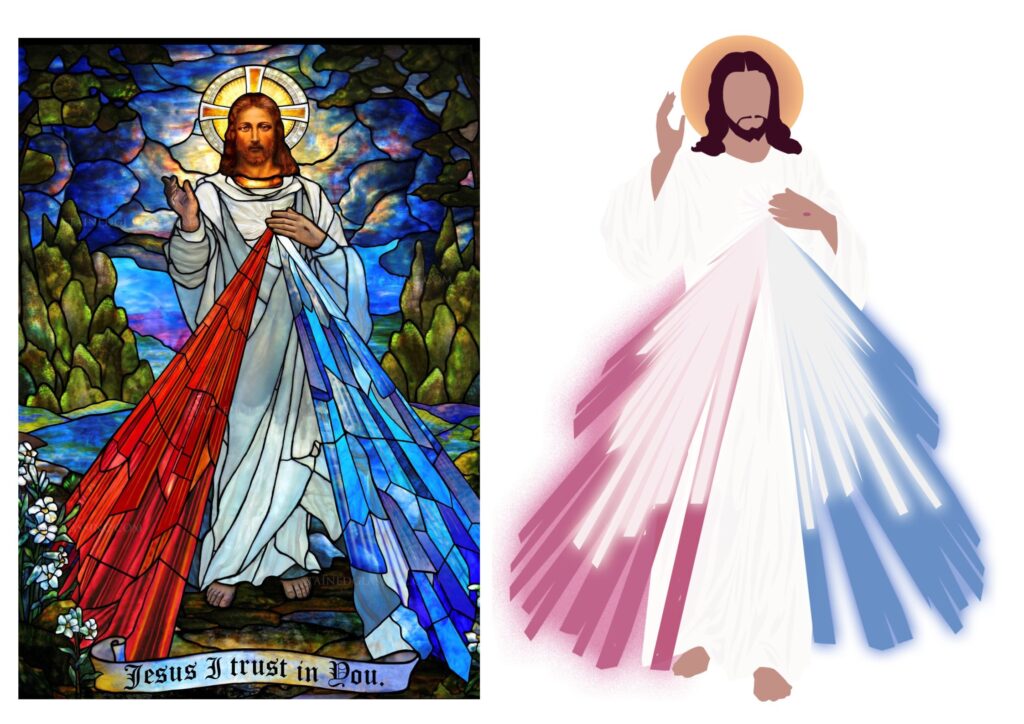
Many people recognise Divine Mercy Sunday because of a special image of Jesus (see below).
In the image, the rays coming from Jesus’ heart represent blood and water:
Prayer Journal
In your prayer journals, we invite you to recreate the famous image of Jesus’ Divine Mercy. If you find drawing people difficult, simply draw a heart, with the two rays flowing from it. Try to colour the rays in or do red and blue outlines of the rays.
🔴 Red Ray – Blood (Life and Sacrifice)
The red ray represents the Blood of Jesus, shown to us in the Eucharist. It reminds us that Jesus gives life and hope to the world.
Inside the red ray, we invite you to write: a person or a situation in the world that needs healing, protection, or mercy.
⚪ Pale Ray – Water (Forgiveness and New Life)
The pale ray represents Water, which reminds us of Baptism and forgiveness. It shows how God washes away sin and brings peace.
Inside the pale ray, we invite you to write, something you are worried about, or a place in your life where you need peace or hope this week.
At the bottom of the page, write the simple Divine Mercy prayer “Jesus, I trust in You”
Let us finish in prayer together…
Jesus,
You know our worries, our mistakes, and our fears.
Thank you for never turning away from us.
Help us to trust in Your mercy,
to offer forgiveness to others,
and to believe that we can always begin again.
Teach us to say, not just with our words, but with our lives:
Jesus, I trust in You.
Amen.
Let us finish this time of prayer together, by making the Sign of the Cross.
In the name of the Father, and of the Son, and of the Holy Spirit, Amen.
Hear
We invite you start our time of prayer today by making the sign of the cross…
In the name of the Father and of Son and of the Holy Spirit Amen
As we heard yesterday, Mercy is God’s love and forgiveness in action.
Jesus teaches the gift of mercy clearly in the Parable of the Good Samaritan. When others pass by a beaten man on the side of the road, a Samaritan stops. He does not see the injured man as an inconvenience, or as someone with different beliefs and values, but as a person worthy of care, compassion and dignity.
Today, we are going to hear the story of the Good Samaritan shared with us in a creative way. This piece has been produced right here in our school by our own Creative Arts Film Club, led by the talented Ms Brown.
As you watch, reflect on how we are called to be brave and merciful like the Samaritan — especially in difficult situations, or when we might disagree with someone else’s beliefs or actions.

Let us pray together,
Loving God,
thank you for teaching us what mercy looks like
through the words and actions of Jesus.
Help us to notice those who are hurting,
to stop and help, when it would be easier to walk by,
and to choose compassion over judgment.
Give us the courage to be merciful in our words,
our actions, and our choices each day.
We ask this prayer through Christ our Lord.
Amen.
Let us finish this time of prayer together, by making the Sign of the Cross.
In the name of the Father, and of the Son, and of the Holy Spirit, Amen.
Do
Good morning, Happy Friday! Let us begin by making the Sign of the Cross:
In the name of the Father, and of the Son, and of the Holy Spirit. Amen.
In 2015–2016, the Church celebrated an Extraordinary Year of Mercy, called by Pope Francis, to remind everyone that mercy is at the centre of Christian life — especially in everyday situations. Can any of our older students remember celebrating it in primary school?
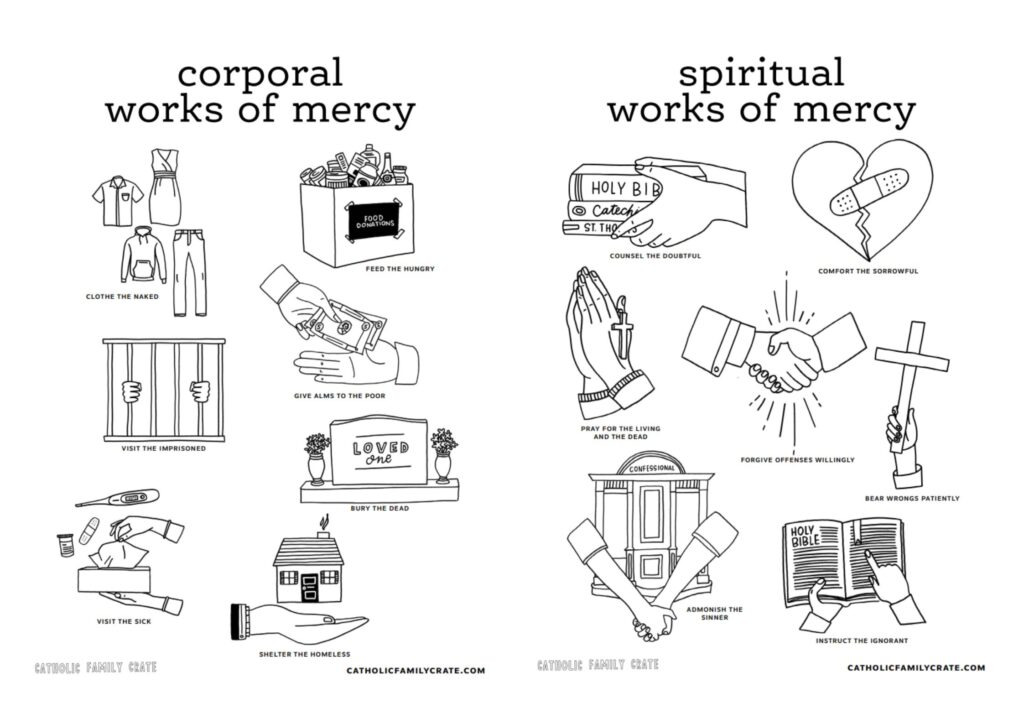
The Church gives us two simple ways of remembering how to live mercy:
There are Corporal Works of Mercy
These are practical actions that help people with their physical needs — things people need to live with dignity.
- feeding the hungry
- giving to the poor
- visiting the sick
- welcoming the stranger
There are Spiritual Works of Mercy
These are actions that care for people’s hearts, minds, and relationships.
- forgiving others
- listening patiently
- comforting someone who is upset
- praying for others
👉 You can see examples of both the corporal and spiritual works of mercy on the images below created by a Catholic illustrate – Catholic Family Crate.
So can you identify works of mercy with a game of charades?
Before the game begins, take a moment to:
- look at the images
- notice which actions are corporal
- and which are spiritual
You don’t need to memorise them perfectly, just start to recognise the difference.
Mercy Charades
How to Play
- Hide the images from the screen.
- Ask for one or two volunteers to come to the front.
- The volunteer is given a Work of Mercy (corporal or spiritual).
- They act it out silently — no talking.
- The rest of the form group must guess: What act of mercy it is, and whether it is corporal or spiritual
To begin with you could use some of the examples from the images so everyone feels confident. Then click on the hidden box for a level up…
Next, volunteers can think of their own scenarios to act out – modern or school‑based examples of mercy.
Let us finish with in prayer…
Loving God,
help us to recognise the needs of others,
both what they need in their lives
and what they need in their hearts.
Give us the courage to act with mercy —
to help, to forgive, to listen and to care.
May our words bring comfort, and our actions show love to our neighbour.
Amen.
Let us finish our prayer with the Sign of the Cross…
In the name of the Father, and of the Son, and of the Holy